How Schools and Education Campuses Can Use GSHP Networks to Cut Carbon and Stabilise Energy Costs
Rising energy costs and tighter carbon requirements are reshaping how schools think about heating - especially on new builds delivered under the Department for Education (DfE) Construction Framework 2025.
In new-build DfE schools, the heating strategy sits at the centre of the bid position, requiring compliance with fossil-fuel-free requirements, credible performance-in-use, and clearly defined delivery assumptions. For contractors and project teams, this places early-stage system design under close scrutiny.
Ground source heat pump (GSHP) networks are increasingly part of that conversation as long-life infrastructure capable of supporting low-carbon heat across schools and wider education campuses.
On school and campus projects, GSHP systems need to be designed early enough to satisfy compliance, prove deliverability on constrained sites and perform reliably over decades of use.
This article explores why GSHP networks are proving to be the preferred fit for educational settings and why early, sector-informed design input is critical to making them work in practice.
The bigger picture: carbon, cost and complexity
Education buildings represent a significant share of the public sector’s carbon footprint. According to the DfE, schools alone account for an estimated 36% of UK public sector building emissions, and even before recent price volatility, annual energy spend across the school estate was reported at £630m in 2019. That figure is widely understood to be higher today.
Against this backdrop, the scale of new-build delivery under the DfE framework is significant - not only funding new schools, but defining how operational energy performance and technical compliance are assessed.
For teams bidding under the framework, heating strategy has to do two things at once. It must demonstrate alignment with DfE output specifications around energy use and mechanical services, while also standing up to scrutiny from a delivery and programme perspective.
The requirements themselves are explicit. New schools are expected to deliver fossil-fuel-free heat, meet minimum operational energy targets and support a fabric-first approach.
This shifts the emphasis from policy intent to practical integration. Heating strategies must show how they will coordinate with layout, plant space, groundworks and programme sequencing - not just that they achieve target metrics.
In that context, GSHP networks are increasingly being considered. Their appeal lies not only in carbon reduction, but in their ability to support long-term performance and cost stability - provided they are underpinned by early, realistic design decisions.
Considering GSHP networks in education settings
School buildings place clear demands on heating systems. They are highly occupied during the day, expected to operate quietly and designed for long service lives with limited tolerance for disruption.
Ground source heat pump networks align well with those conditions. As buried infrastructure, ground arrays provide stable thermal performance, low visual and acoustic impact and long asset lifetimes. Once installed, the ground loop can support multiple generations of plant, allowing future plant replacement without reworking the underlying infrastructure.
From a delivery perspective, GSHP networks integrate most effectively when considered early in the design process. Plant space, external array zones and electrical capacity can be defined alongside other packages rather than retrofitted into fixed layouts later. On larger school sites or multi-building schemes, networks can be configured to serve more than one block, where land take and phasing are addressed at the outset.
Alongside these practical considerations, efficiency and whole-life carbon performance are significant factors. Because heat pumps transfer energy rather than generate it through combustion, they can deliver multiple units of heat for every unit of electricity consumed, reducing operational energy demand over time.
When assessed across a full system life, the carbon profile also differs materially from gas-based alternatives. Modelling of a 1MW system over 100 years shows:
- GSHP total lifetime carbon: 8,371,281 kg
- Gas + VRF system: 24,607,700 kg
That represents close to a threefold reduction in lifetime carbon impact.
For education buildings designed to operate for decades, those carbon differences compound over the full life of the system - this is part of why GSHPs are increasingly considered within DfE projects.
What makes GSHPs work: early design and sector know-how
On education projects, GSHP performance is shaped by how clearly ground conditions, land take, plant space and programme sequencing are defined before layouts and cost plans are fixed. Success tends to reflect clarity around key assumptions — not simply the choice of technology.
Schools and campuses bring specific delivery pressures. Sites are often constrained, programmes tightly governed and heating strategies must align with layout and electrical capacity from the outset. In this context, GSHP design needs to account for interfaces and phasing as part of core scheme development rather than being introduced once positions have hardened.
Experience under public sector scrutiny makes a material difference. Projects delivered within the DfE framework place a premium on proportionate evidence, clear assumptions and designs that withstand technical review.
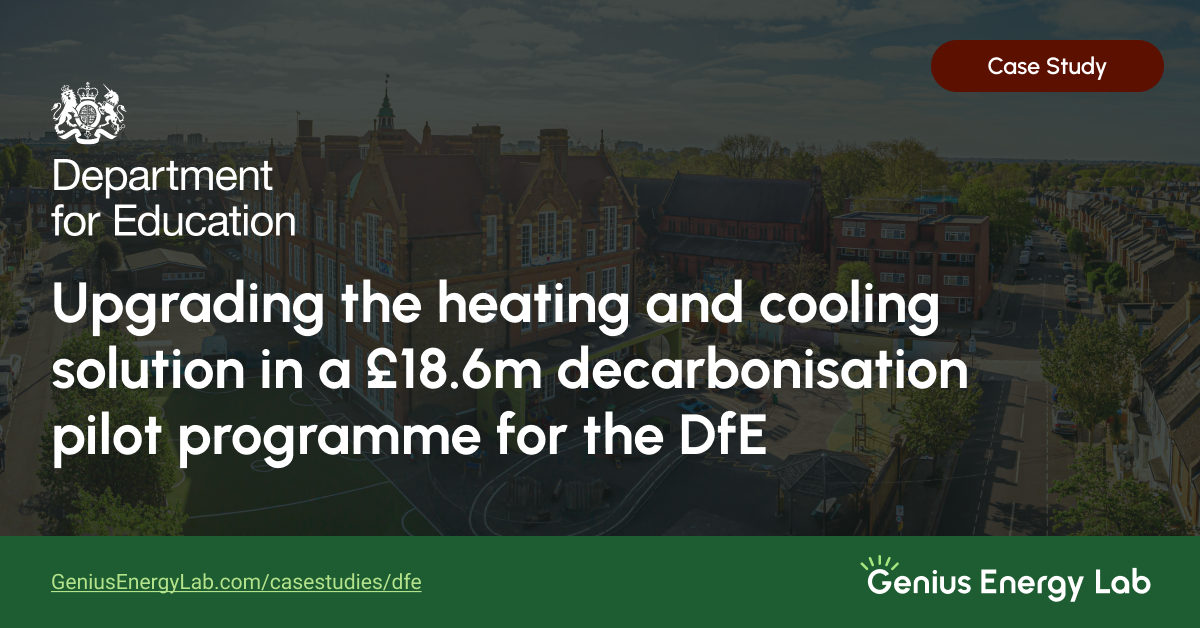
That approach has been shaped in practice through live education projects, including an £18.6m DfE decarbonisation pilot delivering GSHP systems across seven schools in Northern England. Working from feasibility through to design assurance, the project required alignment with DfE specifications, coordination across constrained sites and careful definition of ground and system assumptions.
It reinforced where delivery risk typically sits - and which questions need resolving before schemes move into detailed design and construction.
This is the point at which specialist, design-only input adds value. At Genius Energy Lab, we work upstream of delivery, supporting teams at bid and early design stage to test GSHP suitability, clarify constraints and align designs with education-sector expectations. The result is a GSHP strategy grounded in context that’s built to endure.
For universities: energy strategy meets infrastructure planning
While universities do not operate under the DfE funding framework, many new academic buildings and phased campus developments face similar pressures to decarbonise and stabilise energy costs through operational performance.
Ground arrays are designed around defined building loads with appropriate design margins. Where a phased development strategy is in place, GSHP networks can be configured to allow future connections without redesigning the core infrastructure.
As with schools, early definition of constraints and phasing makes that flexibility achievable.
Building Certainty into GSHP Design
Across both schools and university campuses, the success of GSHP networks is shaped early. Long before equipment is selected or construction begins, outcomes are influenced by how clearly constraints, assumptions and interfaces are understood at the outset.
For education projects operating under funding scrutiny, performance-in-use expectations and long asset lifecycles, those decisions carry long-term consequences. It builds confidence across the project team, limits the risk of late redesign, and helps keep low-carbon heating strategies on track through planning, approval and construction.
Early feasibility, proportionate technical definition and alignment with sector requirements allow GSHP strategies to be tested properly - alongside other options - before positions harden.
We support education projects from the outset with GSHP design expertise that is independent of installation and grounded in public sector delivery experience. We work alongside contractors, consultants and estates teams to help make GSHP systems predictable, efficient and fit for purpose.
The earlier those conversations happen, the fewer surprises teams face later.
Book a Lunch & Learn - an informal call with our technical team - to align your team on early-stage GSHP considerations for schools and education campuses.

Insights from the GSHP experts
Catch up with our latest news and explore our industry knowledge