UK Ambient Loop Heat Network Design: What Developers Need to Know

Ambient loop heat networks are attracting growing interest across residential and mixed-use development. They can connect multiple buildings, draw energy from sources including the ground and waste heat, and provide both heating and cooling through shared infrastructure.
For developers, however, the important question is not simply whether an ambient loop can be installed. It is whether the network will work for the site: its buildings, energy demands, ground conditions, construction programme and long-term operating model.
Those decisions often need to be made early. Boreholes compete for space with foundations and utilities. Plant and distribution routes influence building layouts. Developments may be occupied in phases, long before every planned load or energy source is connected. By the time the energy strategy reaches detailed design, some of the most important choices may already have been made.
This matters because heat networks are expected to play a much larger role in the UK’s energy system. The government expects them to provide up to 20% of the country’s heat by 2050, compared with around 3% today, while shared ground loops and other heat pump-led systems are gaining greater attention as lower-temperature alternatives to conventional district heating.
Yet the language surrounding these systems is not always clear, and their performance depends on more than selecting the right technology. Developers need to understand what an ambient loop is, where it may be appropriate and what good design involves from initial feasibility through to commissioning and operation.
Heat network terminology in 60 seconds
A heat network is shared infrastructure that supplies heating, cooling or hot water to more than one consumer. Within that broad definition, several different system types are commonly discussed.
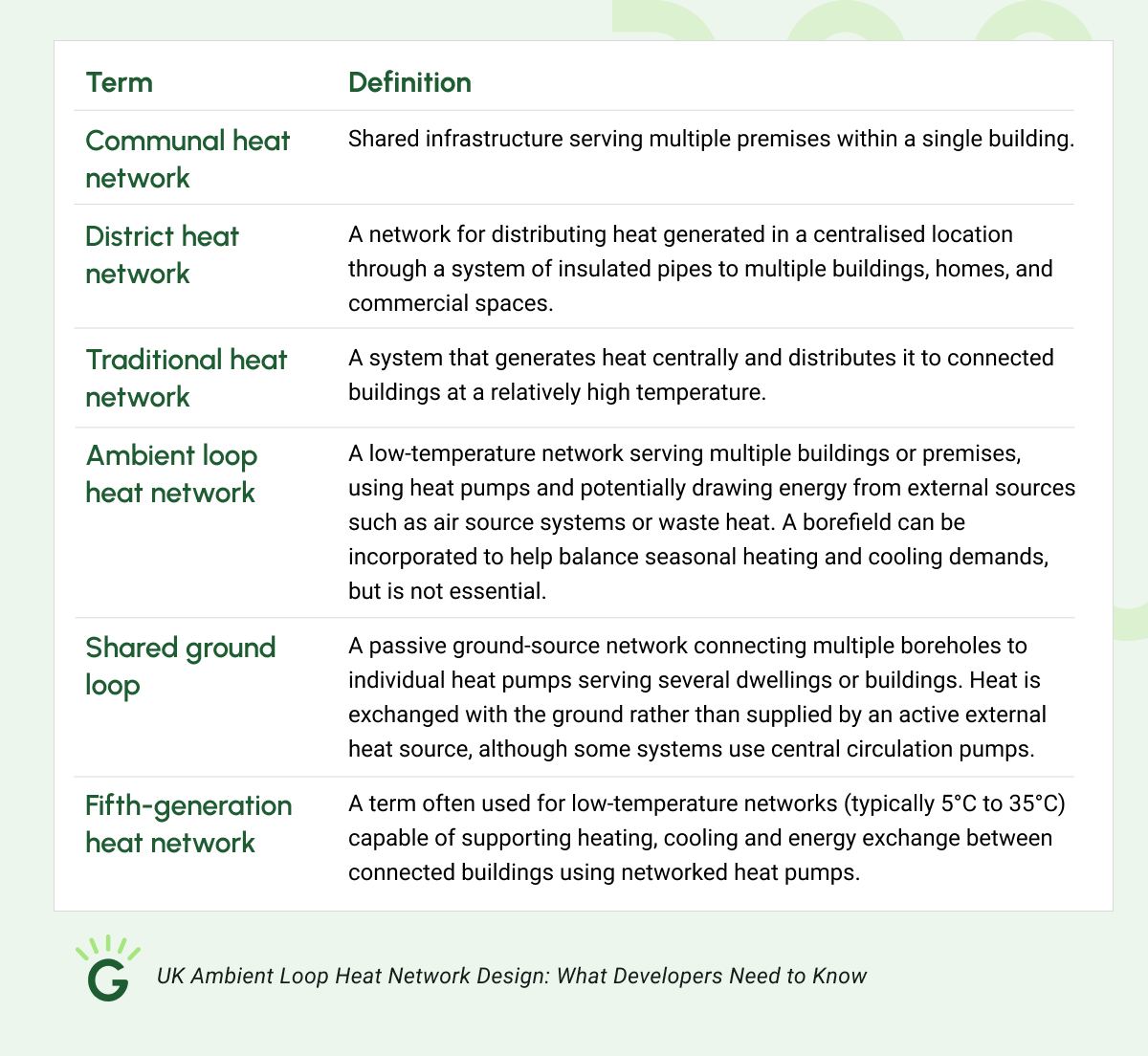
Communal heat network
Shared infrastructure serving multiple premises within a single building.
District heat network
A network for distributing heat generated in a centralised location through a system of insulated pipes to multiple buildings, homes, and commercial spaces.
Traditional heat network
A system that generates heat centrally and distributes it to connected buildings at a relatively high temperature.
Ambient loop heat network
A low-temperature network serving multiple buildings or premises, using heat pumps and potentially drawing energy from external sources such as air source systems or waste heat. A borefield can be incorporated to help balance seasonal heating and cooling demands, but is not essential.
Shared ground loop
A passive ground-source network connecting multiple boreholes to individual heat pumps serving several dwellings or buildings. Heat is exchanged with the ground rather than supplied by an active external heat source, although some systems use central circulation pumps.
Fifth-generation heat network
A term often used for low-temperature networks (typically 5°C to 35°C) capable of supporting heating, cooling and energy exchange between connected buildings using networked heat pumps.
These terms can overlap. A shared ground loop may be one form of ambient network, while an ambient loop can serve either multiple premises in one building or a larger group of buildings.
These terms can overlap, but there are important differences. Ambient loops can incorporate active heat sources, such as air source heat pumps or recovered waste heat, and may use borefields to help balance energy demand across the seasons. Shared ground loops, by contrast, rely on passive heat exchange with the ground, although circulation pumps may introduce some operating costs.
The important distinction is where the energy comes from, how it moves through the system and what is required to keep it operating efficiently.
How does an ambient loop heat network work?
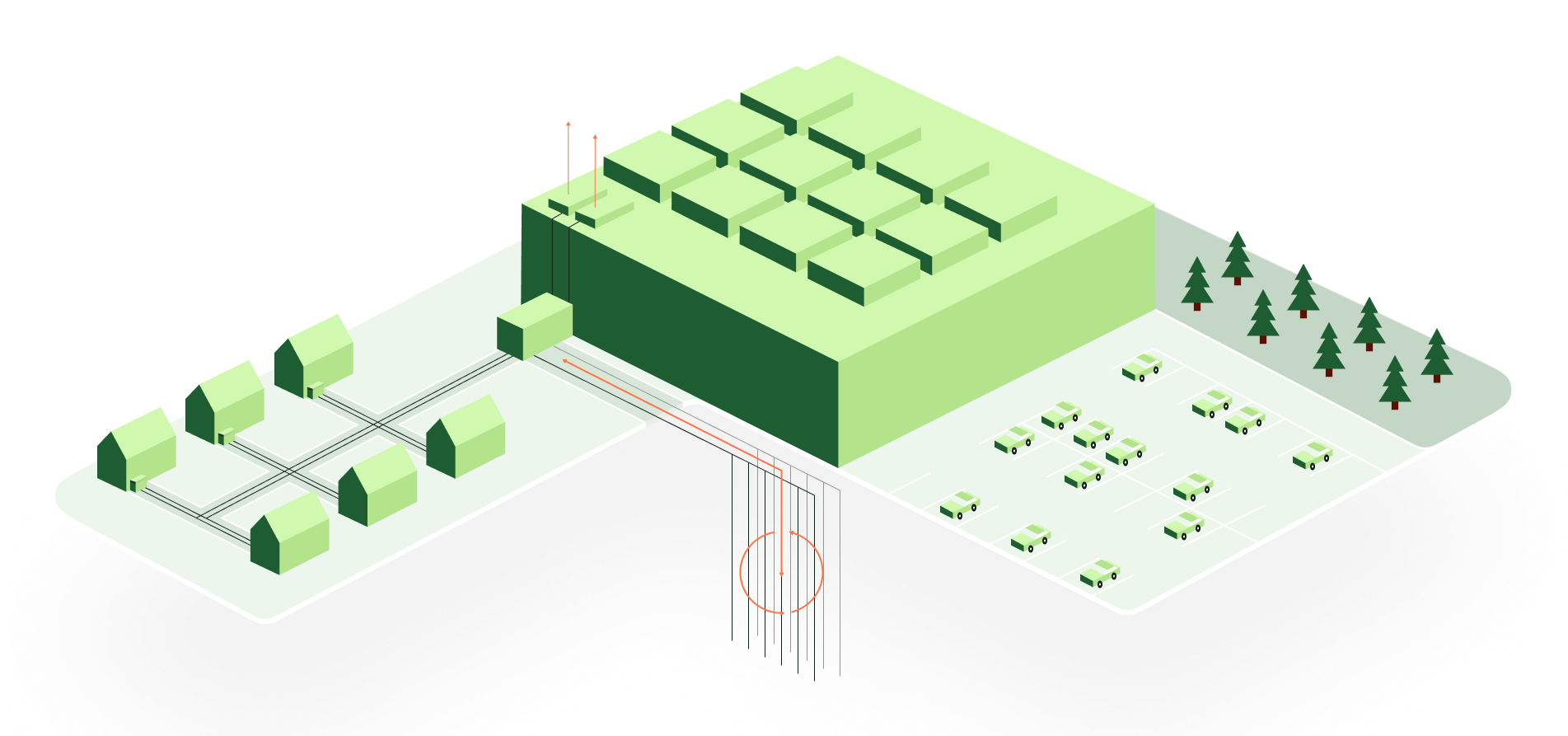
An ambient loop connects multiple buildings or properties through shared pipework. Energy can be supplied to the loop from the ground, groundwater, surface water, waste heat or a combination of sources.
Rather than distributing high-temperature water over long distances, the loop operates within a relatively low temperature range. Heat pumps located within individual buildings or premises extract energy from the network and raise it to the temperature required by the local heating and hot-water system.
Where cooling is needed, the process can operate in reverse. Heat removed from one part of a development may be transferred back into the network and used elsewhere, subject to the system configuration and the balance of demand.
This creates opportunities on mixed-use developments where heating and cooling loads occur at different times. For example, heat rejected by commercial or retail space could contribute to the energy available to residential properties. Ground arrays, aquifers or other sources can also help balance the network over longer periods.
The potential benefits include:
- Lower distribution losses than higher-temperature networks
- Heating and cooling through shared infrastructure
- The ability to draw on several low-carbon or recovered energy sources
- Greater flexibility for mixed-use and phased developments
- Reduced reliance on large rooftop plant
- Opportunities to share energy between buildings
- The potential to add new sources and connections as a development evolves
These benefits are not automatic. They depend on the relationship between the buildings, their energy demands, the available sources and the way the network is designed and controlled.
How do shared ground loops work?
Shared ground loops offer another approach to delivering low-carbon heating across multiple properties, particularly residential developments and housing estates.
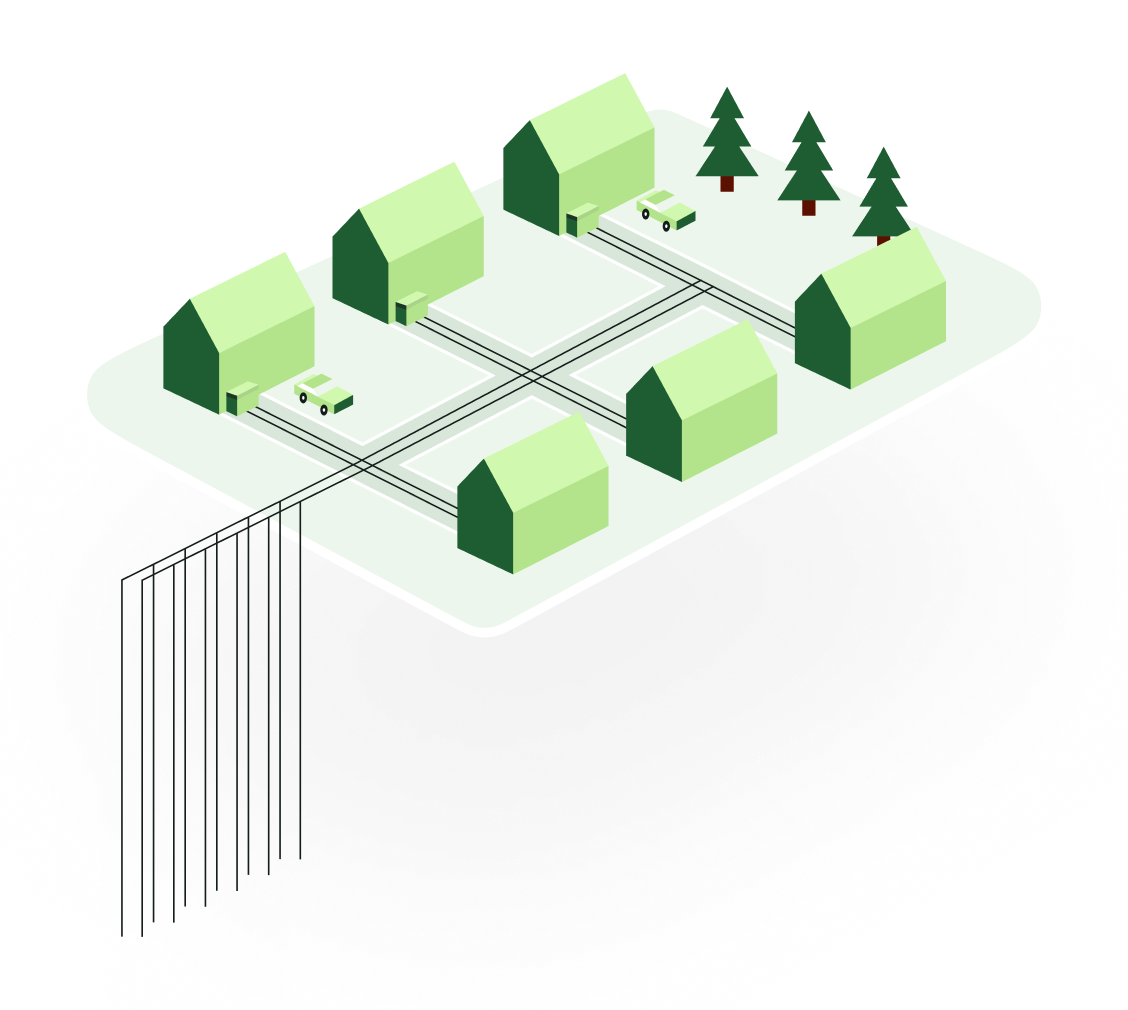
Rather than each dwelling requiring its own borehole, a shared ground loop connects a network of boreholes to individual ground source heat pumps in multiple homes. Each heat pump extracts energy from the shared ground infrastructure and raises it to the temperature needed for heating and hot water.
Unlike ambient networks that incorporate active heat sources, a conventional shared ground loop relies on passive heat exchange with the ground. There is no need for a separate heat source to inject energy into the network, although some configurations use central circulation pumps, which introduce an operating cost.
What are the advantages of shared ground loops?
For developers and housing providers, shared ground loops can offer several benefits:
- Shared infrastructure: Multiple properties can access the same ground array rather than requiring separate boreholes for each home.
- Individual control: Each dwelling has its own heat pump, allowing occupants to manage their heating and hot water independently.
- Long-term infrastructure: Boreholes provide a durable energy asset that can support heating and cooling over decades.
- Potentially lower network operating costs: Passive heat exchange avoids the need for active heat generation at network level, although pumping and maintenance costs still need to be considered.
As with any ground source system, performance depends on getting the design right. Borehole capacity, ground conditions, the number of connected properties and their heating demands must all be assessed to ensure the shared infrastructure can perform efficiently over its lifetime.
Why are ambient loop networks receiving more attention?
The direction of UK heat policy is clear. The government expects heat networks to provide one-fifth of national heat demand by 2050 and sees zoning as a way to identify areas where networks are likely to offer the lowest-cost, low-carbon option. Its current plans include a target for heat networks to meet 7% of heat demand in England by 2035.
The regulatory environment is also becoming more formal. Ofgem assumed responsibility for regulating heat networks in Great Britain in January 2026, bringing heat-network customers within a dedicated consumer-protection regime.
The Heat Network Technical Assurance Scheme, or HNTAS, is planned to launch in 2027. It will introduce minimum technical standards and lifecycle assessment points for new and existing networks, covering feasibility, design, construction, commissioning and operation.
This is an important change for developers. Technical performance, evidence and accountability will need to be considered throughout the project rather than assessed only at handover. For new networks, the proposed HNTAS process includes assessment points before design, construction and operation, followed by further assessment after two years of operation.
At the same time, Heat Pump Association UK has called for shared ground loops and ambient networks to receive clearer recognition within heat-network zoning, regulation and funding. Its recommendations also highlight the need for proportionate technical requirements, more consistent drilling permissions, improved ground data and further skills development.
The market is therefore moving in a defined direction, even if parts of the delivery framework are still catching up. Developers do not need to predict every future policy detail, but they do need to understand whether the infrastructure they are planning can perform within a more regulated, evidence-led market.
Why ambient loop design is different
On paper, an ambient loop can look elegantly simple: connect the buildings, circulate water at a low temperature and let individual heat pumps do the rest. In practice, its success depends on how well the whole development works as an energy system.
An office rejecting heat on a summer afternoon could potentially support another building’s demand. A borehole field could provide a dependable source of energy for decades. A network designed for the completed development may also need to serve its first occupied phase when only a fraction of the planned buildings are connected.
These opportunities - and complications - make ambient loop design different.
The timing of demand matters
Annual energy totals only tell part of the story. Designers also need to know when heating and cooling are required, how long the peaks last and whether different loads coincide.
Mixed-use schemes can offer a useful balance. Offices, homes, shops and leisure facilities often have different energy profiles, creating opportunities to share heat across the development. But diversity only has value when the timings work: a cooling load in July cannot directly meet a heating demand that arrives in January.
The ground has limits
Where a network uses boreholes, aquifers or other ground infrastructure, geological conditions must be investigated rather than assumed. Available space, drilling access, groundwater, thermal conductivity and nearby foundations or utilities will all shape what is possible.
The ground is not an unlimited battery, either. If the system repeatedly extracts more heat than it replaces - or rejects more than the ground can absorb - performance may decline over time. Long-term modelling helps establish whether the system can remain balanced throughout the life of the development.
Buildings and network must work together
Heat pumps work most efficiently when they do not have to make a large jump between the temperature of the source and the temperature required inside the building.
That means loop temperatures cannot be designed in isolation. Internal emitters, domestic hot-water requirements and building controls all influence performance. An efficient network connected to buildings demanding unnecessarily high temperatures will still use more electricity than it should.
The finished development is not the only design condition
Most large residential and mixed-use schemes are delivered in phases. Before the final building is connected, the network may have only part of its intended demand: or be missing an energy source that will eventually help to balance it.
The design must account for this period. That could mean adapting how the early network operates, providing supplementary plant or creating a clear route for later connections.
Controls turn components into a system
An ambient network brings together energy sources, circulation pumps, individual heat pumps, building controls and meters. Each component may work perfectly well on its own, but that does not guarantee that the network will perform well as a whole.
The control philosophy, monitoring requirements and operational responsibilities therefore need to be developed during design, with enough data available to identify and correct performance issues once the buildings are occupied.
Feasibility must come before technology selection
The first question should not be how many boreholes a development needs or which heat pump should be specified. It should be whether an ambient loop is the right solution for the site, the buildings and the commercial objectives of the project.
This work allows different configurations to be tested before the project team becomes committed to one approach. It can also prevent a viable ground source or ambient loop system from being rejected using broad rules of thumb that do not reflect the conditions of the individual site.
On dense urban projects, early feasibility has a wider commercial value. Energy infrastructure competes with foundations, utilities, transport assets, landscaping and revenue-generating space. Establishing the potential system architecture early helps the design team coordinate these requirements while there is still scope to influence the project.
What does this mean for developers and contractors?
Ambient loop networks can give project teams more options for delivering low-carbon heating and cooling, particularly across high-density residential, mixed-use, regeneration and multi-building developments.
They can also help protect lettable or saleable space by making use of ground infrastructure and reducing the requirement for extensive rooftop equipment. On developments with complementary loads, they create opportunities to recover and share energy rather than treating heating and cooling as separate services.
However, an ambient loop is not automatically the best answer for every site. Its value depends on the available sources, the balance of demand, site constraints, building design and commercial structure.
The opportunity lies in assessing those factors early enough to make an informed decision. When feasibility is delayed, the project may lose access to suitable drilling areas, become committed to incompatible building systems or inherit assumptions that are expensive to correct later.
Independent design from feasibility to delivery
Genius Energy Lab works with developers, commercial construction firms, architects, M&E contractors and consultants to assess and design ground source and ambient loop heat networks.
As an independent design consultancy, GEL does not sell heat pumps or compete for the installation package. Its role is to establish what is technically and commercially viable, develop the system design and help the wider project team protect its performance through procurement, construction and commissioning.
Support can include:
- Site and project feasibility studies
- Ground and geological assessment
- Heating and cooling load analysis
- Energy strategy development
- Ground array and ambient loop design
- Concept, developed and technical design
- Technical specifications and procurement support
- Construction-stage design support
- Commissioning and performance oversight
As the UK heat-network market expands, the quality of early decisions will have a direct bearing on cost, compliance and long-term performance. For developers considering an ambient loop, the most useful starting point is not a predetermined technology or specification. It is a detailed understanding of the site, its energy demands and the infrastructure needed to serve them successfully.
Planning a residential, commercial or mixed-use development? Speak to Genius Energy Lab about ambient loop feasibility and heat-network design.

Insights from the GSHP experts
Catch up with our latest news and explore our industry knowledge